Potty training a puppy feels like it should be about the puppy, but it is mostly about the clock. Puppies learn fastest when their owners take them out on a reliable schedule, reward the right spot, and stay calm through the accidents. This guide covers fifteen routine fixes, from when to go out to what to do when it goes wrong, all without punishment.
Before you start
Two rules carry the whole method.
Prevent first, then teach. Every accident that happens indoors is a repetition your puppy did not need to practice. The faster you get the puppy outside in time, the faster the right habit forms. This is why the schedule below is so consistent in the first weeks: prevention is the training.
Never punish. When you find an accident, it is already history for your puppy. Reacting tells them that going in front of you is dangerous, which teaches them to hide it - not to stop. Clean up, adjust the timing, and move on.
Have three things ready before day one (our new puppy checklist has the full list): an enzymatic cleaner, a crate or a pen for when you cannot supervise, and treats that are small, soft and easy to eat fast.
The 15 fixes
1. Take the puppy out on a timer, not on a signal
Waiting for your puppy to signal means waiting for a near-miss. Puppies give signals late and inconsistently, especially in a new home. Instead, set a timer (the potty training schedule by age shows how the gaps grow): every hour or two during waking hours for the first weeks, and more often after eating, waking and play. If your puppy is eight weeks old, one hour is a reasonable starting gap. You are not being overly cautious - you are giving the puppy more chances to succeed than to fail.
2. Make the morning trip the first thing that happens
A puppy’s bladder empties overnight, so the morning trip is the most important one of the day. Carry your puppy outside if the door is far from where they slept - walking on their own can trigger a stop-and-go. Get them to the spot before they have a chance to squat. A clean night followed by a successful morning trip sets the whole day’s rhythm.
3. Go out immediately after every meal
Puppies digest fast. Most need to go within five to fifteen minutes after eating, and the younger the puppy, the closer to the short end of that range. Take the puppy out right after the meal, wait calmly, and reward when they go. This is one of the most predictable triggers you have, so use it every single time.
4. Go out after every nap
A puppy who just woke up is a puppy who needs to go - almost always. The same way the morning trip protects the night, the after-nap trip protects every nap during the day. If your puppy sleeps in a crate, open the door and head straight outside. Do not let them stretch, wander or greet you first. Movement and excitement before the trip are how accidents happen.
5. Go out after every play session
Excitement fills the bladder fast. The moment play winds down, take the puppy out. This is also why it is worth ending play sessions calmly rather than in a frenzy: a puppy who is already on the way outside is a puppy who cannot have an accident on the way. Keep the pattern identical every time - play ends, outside, reward.
6. Use the same door every time
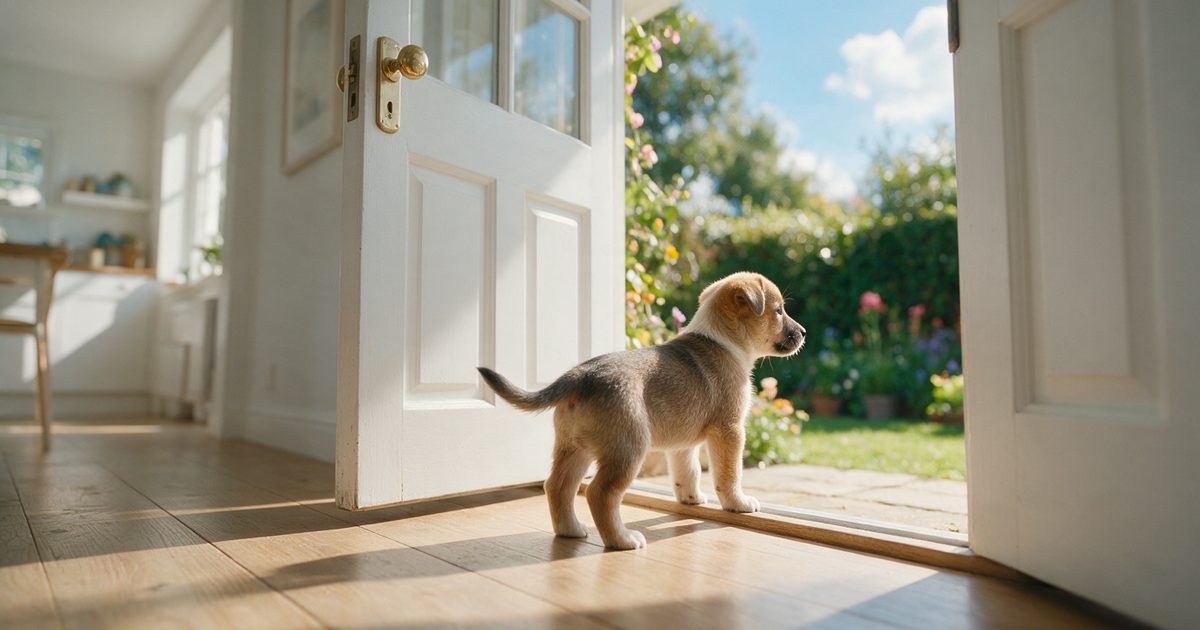
Puppies learn locations, not concepts. If you always use the back door, the front door becomes confusing and the hallway becomes an option. Pick one door for potty trips and use it exclusively for the first weeks. Your puppy will start heading to that door on their own, and that is a signal worth encouraging - because it is the right door.
7. Walk to the same spot in the yard
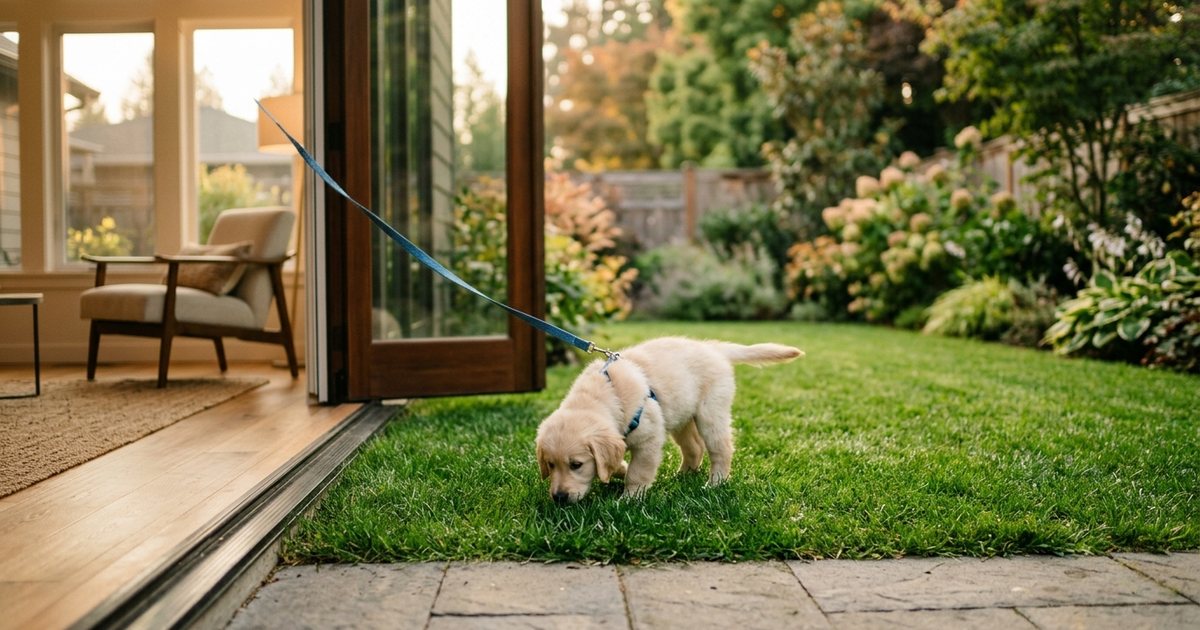
The same logic as the door, one level further. A puppy who always goes in the same corner of the yard connects that spot with the job. The scent of earlier trips may help your puppy recognize the spot. Choose a spot away from where they play, and lead them there every time without detours or long sniffs first.
8. Pick a cue word and say it at the spot
Choose a word you will never use anywhere else - “go potty” or “hurry up” - and say it calmly once the puppy is at the spot. Say it in the same tone every time. The word becomes a signal that this is the place and the time. Within a few weeks you will be able to use it in a new location and your puppy will understand the request.
9. Wait it out calmly for two or three minutes
Give the puppy time to work, but do not stand there forever. Two or three quiet minutes at the spot is enough. Do not talk to them, do not chase them, do not re-sniff the whole yard. If nothing happens, go back inside, keep them near you or in the crate, and try again in fifteen to twenty minutes. The trip is a skill, and it gets faster with practice.
10. Reward the instant they finish
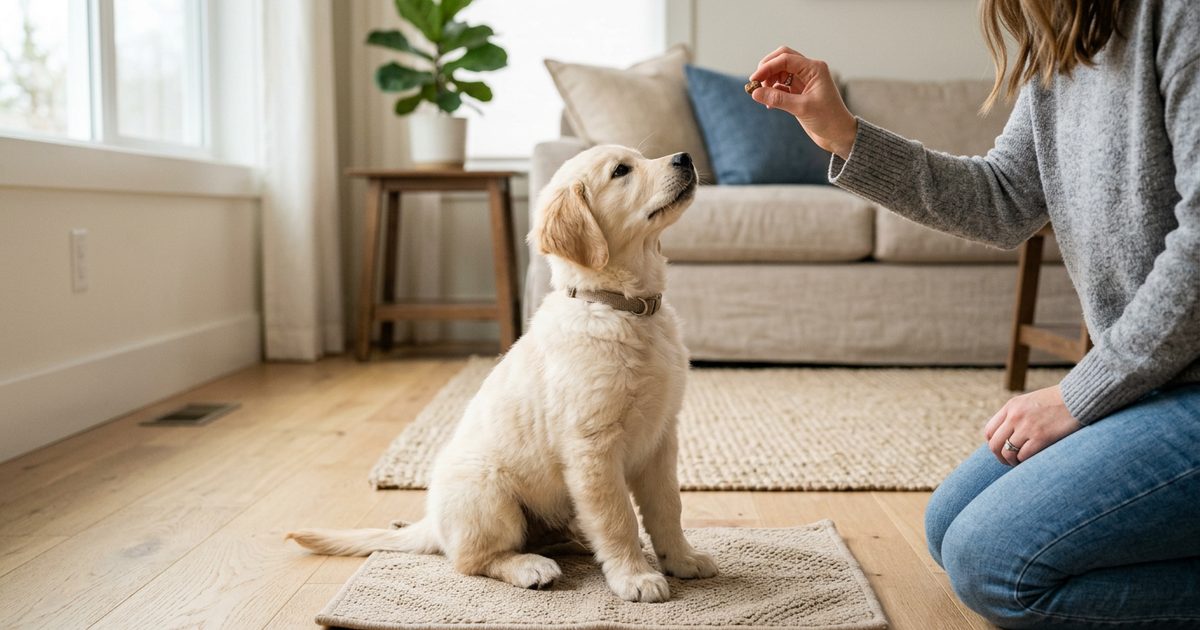
The reward has to land in the second after the puppy finishes, not later. Keep treats beside the door so you are not fumbling. The sequence is: puppy goes, treat appears, calm praise. If you wait until you are back inside, the puppy has already connected the reward with being inside, which is the opposite of the lesson. Speed beats size - a pea-sized treat instantly is worth more than a handful later.
11. Clean accidents without a word
When you find an accident, say nothing, pick the puppy up (if they are still there), and take them out anyway. Then clean up with an enzymatic cleaner that breaks down the odor. Scolding, pointing or sighing at the scene can teach your puppy to be afraid of you near the mess - not to stop making it. A calm cleanup is one of the hardest habits for owners and one of the most useful.
12. Use an enzymatic cleaner, not a regular one
Regular cleaners mask the smell, and to a puppy nose the spot still reads as a toilet. Enzymatic cleaners break down the proteins in urine so the spot genuinely stops smelling like a toilet. Avoid ammonia-based products entirely - ammonia is part of urine’s scent, so the cleaned patch can actively invite a repeat. Buy enough; in the first weeks you will use more than you expect.
13. Limit freedom until the routine sticks
A puppy with run of the house is a puppy with too many spots to fail in. For the first weeks, keep the puppy in the room you are in, attached to you by a short leash or behind a baby gate, and crate or pen them whenever you cannot watch. This is not punishment - it is the prevention step from the start of this guide. Freedom is a reward that comes back as the routine proves itself.
14. Use the crate for the gaps you cannot cover
A crate can help prevent accidents during short gaps when you cannot supervise. Take the puppy out as soon as they are released. The crate is a tool for rest and prevention, not a place to put a puppy out of the way. Introduce it gradually rather than shutting the puppy in and waiting out distress. Our guide to crate training a puppy walks through the steps.
15. Keep a log for the first two weeks
Write down the time of every trip and every accident. After a few days the pattern appears: the gap that was too long, the hour that always goes wrong, the signal you missed twice. Adjust the schedule to the log instead of guessing. Most owners stop logging once the routine is steady, but the first two weeks of data are what make the routine steady in the first place.
Common mistakes
Waiting for the puppy to ask. The puppy will ask, eventually, and usually too late. A timer beats a signal every time in the first weeks.
Punishing accidents. It does not work, it makes the puppy hide the act, and it teaches them to fear you near the mess. Clean up silently and change the timing.
Giving the whole house at once. Every room is a new training ground. Start with one room and expand only after weeks of clean days there.
Rewarding late. A treat after coming inside teaches the wrong lesson. The reward has to land the moment the puppy finishes.
Expecting a full night at eight weeks. Most young puppies cannot hold it all night. A middle-of-the-night trip is normal; skipping it because you want the puppy to hold on just trains accidents.
When to ask a professional
Get your vet involved if your puppy strains to go, urinates far more often than the schedule suggests, or suddenly starts having accidents after a stretch of clean days - frequent urination and accidents after being reliable can point to a urinary tract issue, and that is a medical question, not a training one.
For the training side, a qualified force-free trainer is the right call if the routine is consistent and the puppy still cannot hold it, or if your puppy is frightened around the crate or the door and the fear is not settling with distance and patience. Potty training should be boring and calm; if it is turning into fear, stop pushing and get help before the pattern hardens.
Sources
Guidance checked on September 2, 2026: