Puppy obedience training does not need an hour a day. It needs a few minutes, a handful of treats and a clear plan. Below are six short blocks. Pick two or three each day, rotate, and in a few weeks your puppy has the basics that make daily life easier.
Every block uses food rewards. VCA calls teaching puppies what to do through praise and rewards the best practice, and advises that sessions should be no more than a few minutes long at first, a few times a day.
Before you start
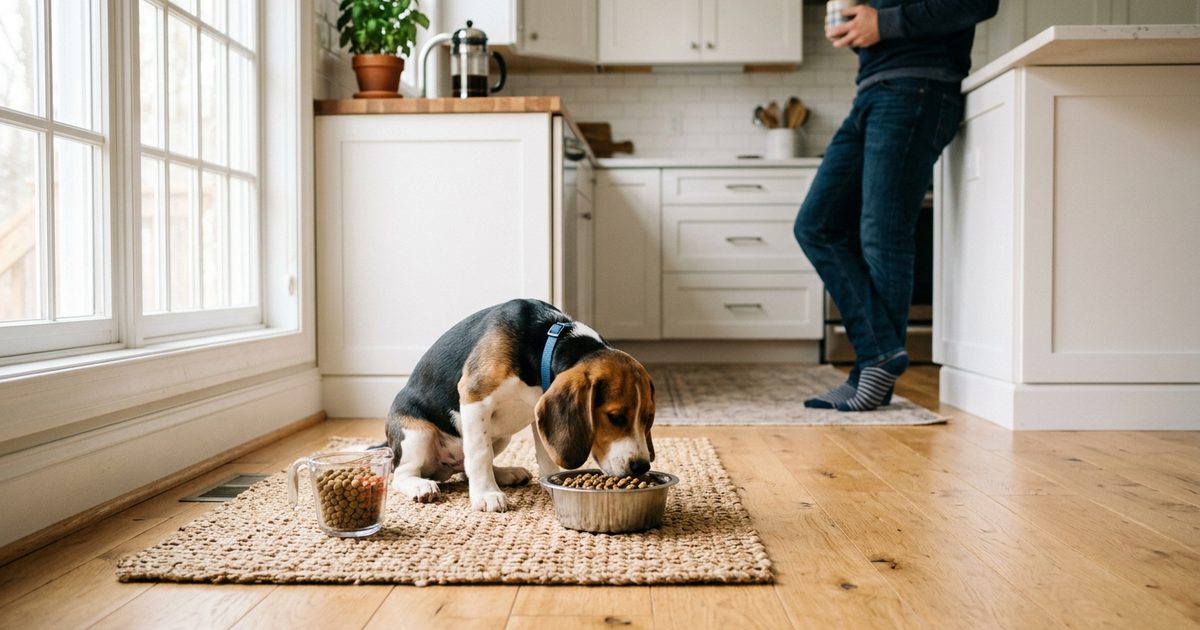
- Small, soft treats. Pea-sized. Use part of your puppy’s daily food to avoid overfeeding.
- A marker word. “Yes” at the exact moment your puppy gets it right, then the treat.
- A quiet room first. Add distractions later, one at a time.
- Stop early. End while your puppy still wants more.
Block 1: Name and attention
Goal: your puppy looks at you when you say their name.
- Say the name once, in a normal voice.
- The moment your puppy looks at you, “yes” and a treat.
- Repeat five times, then stop.
Later, say it when your puppy is sniffing something mildly interesting. Never use the name before something unpleasant.
Block 2: Sit
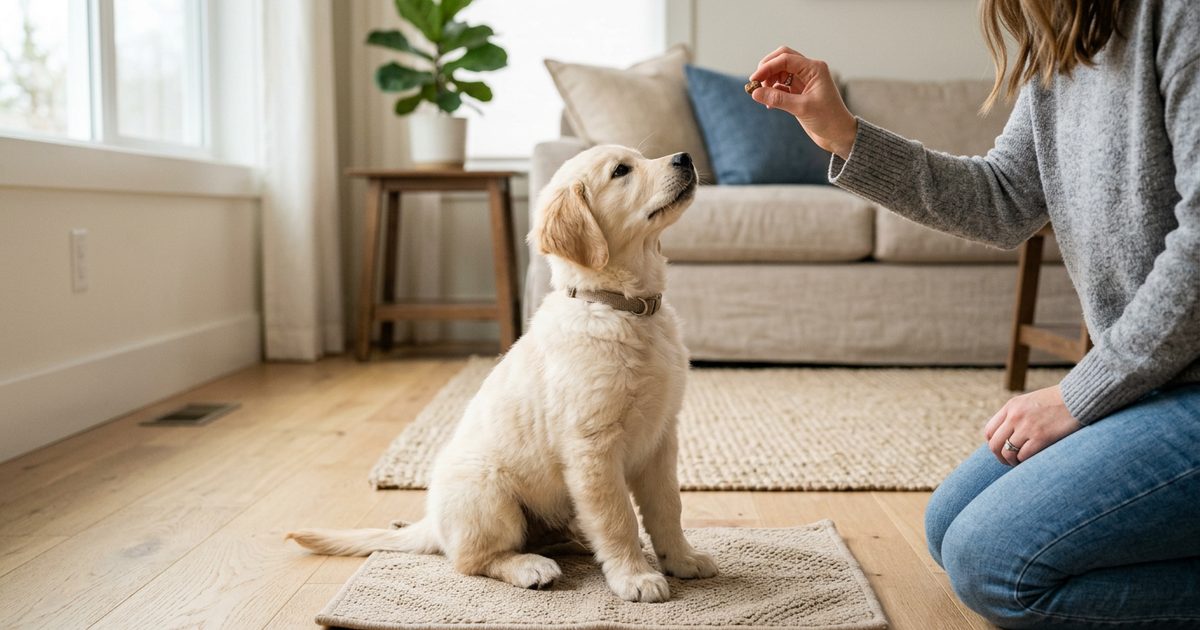
Goal: your puppy sits on a hand signal, then on the word.
- Hold a treat at your puppy’s nose.
- Lift it slowly up and slightly back. As the head goes up, the rear goes down.
- “Yes” and the treat the moment they sit.
- After a few repetitions, use the same movement with an empty hand, and reward from the other hand.
- Once the hand signal works, say “sit” just before the signal.
This follows the luring method described by the AKC.
Block 3: Down
Goal: your puppy lies down on cue.
- From a sit, hold a treat at the nose and lower it slowly to the floor between the front paws.
- “Yes” and the treat when the elbows touch the floor.
- If your puppy stands up, start again with a smaller movement.
You can also capture it: wait for your puppy to lie down on their own, reward, and name it once it happens often.
Block 4: Come
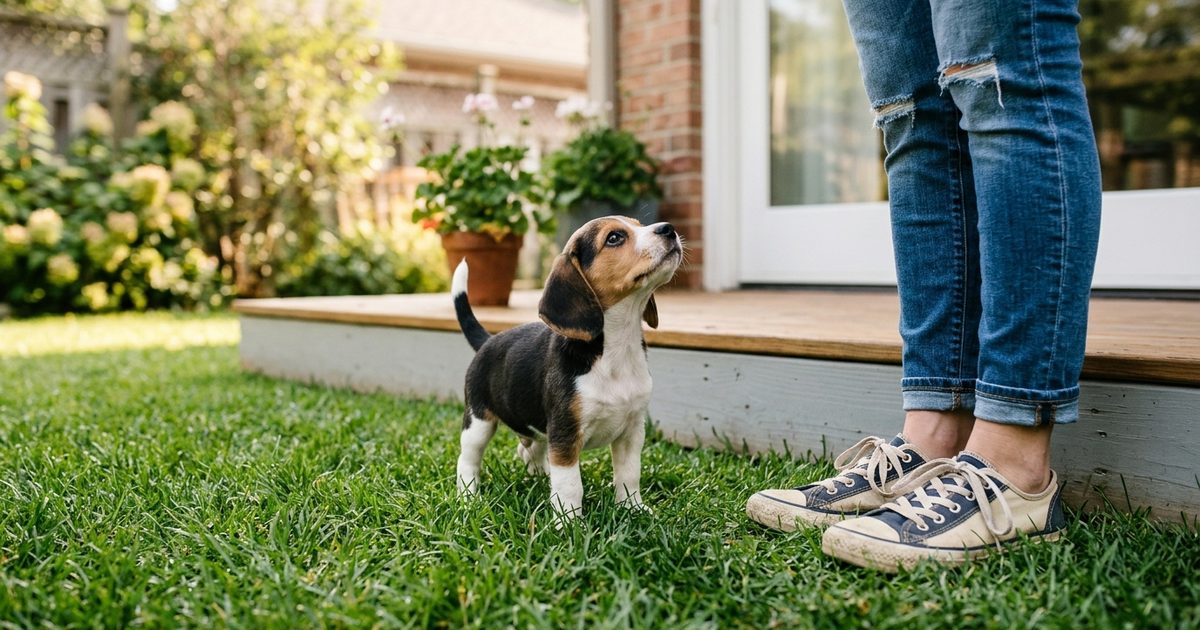
Goal: your puppy runs to you when called.
- Start two steps away in a quiet room.
- Say the name and “come” in a happy voice, and step backwards.
- When your puppy reaches you, “yes” and a treat, plus a moment of praise.
- Add distance slowly. Outdoors, use a long line.
Rules: never call your puppy for something they dislike, never chase them, and make coming to you the best deal of the day.
Block 5: Leave it
Goal: your puppy ignores something they want, because you offer something better.
- Hold a treat in a closed fist. Let your puppy sniff and lick.
- The moment they pull away, “yes” and a treat from the other hand.
- When that is easy, say “leave it” as you present the fist.
- Progress to a treat on the floor under your hand, then uncovered.
This is one of the most useful safety skills you can teach.
Block 6: Loose leash basics
Goal: your puppy learns that being next to you pays.
- Indoors, with the leash on, walk a few steps.
- Whenever your puppy is at your side, “yes” and a treat right at your leg.
- If the leash goes tight, stop and wait. When it goes slack, carry on.
Keep these sessions very short. Walking on a leash outside is much harder than it looks.
Putting it into your day
Fold blocks into the routine you already have. A block before breakfast, a block during a toilet trip, a block in the evening. Our puppy training schedule shows where they fit, and the schedule by age shows when to move each skill outdoors. For the bigger picture, see our puppy training guide, and for older puppies the 6 to 12 month plan.
Common mistakes
Repeating the cue. Say it once. If your puppy does not respond, help them or make it easier.
Late rewards. The marker has to land at the right moment.
Too many changes at once. New place and longer duration and more distance all at once is too much.
Using corrections. Leash pops and harsh words make training less clear and can make puppies wary.
When to ask a professional
Join a force-free puppy class for feedback and practice around other dogs. Contact a qualified trainer if your puppy seems stressed during training, avoids you, or makes no progress after a few weeks. Speak to your vet if your puppy seems reluctant to sit or lie down, since pain can look like disobedience.
Sources
Guidance checked on September 27, 2026: